

Electric Heater
alaindustrial:electric_heater
Summary
The Electric Heater sits directly below a Vulcanizer and gives it the maximum heat level — 3, that is three rubber from one portion of ingredients instead of one on a campfire.
But not right away. This is a furnace that has to be lit: a cold heater is not a heat source at all, and the Vulcanizer above it simply waits for it to reach working temperature. Warming up takes about ten seconds, after which the machine starts straight at ×3.
Mini-example: put the heater under a Vulcanizer, run an LV cable to it and load the ingredients. For the first ~10 seconds nothing happens, the thermometer on the heater's screen climbs and the coils of the block light up. The moment the thermometer is full the rubber starts coming — three at a time.
Energy
| What | Value |
|---|---|
| Internal buffer | 2400 EU/FE |
| Max input | 32 EU/FE/t (LV) |
| Consumption | 6 EU/FE/t |
| Warm-up | 200 ticks (~10 s), 1200 EU/FE |
| Draw with nothing to heat | 0 EU/FE |
The heater is the most expensive part of the pair: 6 EU/FE/t against the 2 EU/FE/t of the Vulcanizer itself. That is by design — heat is exactly what it produces, and at the old rate it came out cheaper than the machine it serves and was not felt at all. Together the pair draws 8 EU/FE/t, which still fits into a copper cable (12 EU/FE/t).
The numbers close on each other: the warm-up costs 1200 EU/FE, one Vulcanizer batch costs exactly the same, and the buffer is 2400 EU/FE. In other words, a fully charged heater can light itself up and run one batch even with the cable cut.
Warming up spends energy in its own right — it is the only mode in which the block pays for something other than somebody else's work. But it does not start "just because power is connected": it starts only when the machine above really has nothing to do but wait for heat. A heater with no machine above it, or under a machine with no ingredients, still stands cold and spends nothing.
If the machine above is sped up with Overclockers, the heater pays the same multiplier — otherwise an overclocked pair would pay less for its heat. The heater has no upgrade panel of its own: the multiplier arrives from the machine it heats.
Careful with overclocking. On the third overclocker step the machine above asks the heater for 48 EU/FE/t, while its LV input holds only 32. The buffer will carry such a pair for a while, then the heater starts falling behind. The practical ceiling for the pair is the second step.
Cooling down
Left with nothing to heat, the heater cools down twice as slowly as it warmed up: the full slide back takes about 20 seconds. That is deliberate slack for pauses — a hopper that held the ingredients back for a couple of seconds costs you a small slice of the warm-up, not all of it.
Cooling down is free. And while the machine above is waiting for work — standing without energy of its own, say — the heater holds its temperature and spends nothing while doing so: it does not throw the warm-up away just because its neighbour temporarily has nothing to pay with.
Interface
The screen opens on right-click. It has no slots — there is nothing to put into the heater; it takes energy from the cable and gives heat upwards. The screen is there so that the warm-up can be watched and planned instead of guessed.
| Left | Right |
|---|---|
| Energy bar | Warm-up thermometer |
The thermometer fills along an incandescence scale — dark ember through red-orange to bright gold at full warm-up. That last step is easy to spot: it is exactly what marks the machine above starting to work.
| Row | What it means |
|---|---|
| Warm-up | Temperature in percent — always the real one, it is a property of the block itself |
| Heat | ×3 when heat is really being given away, and a dash while the heater is still warming up |
| Draw | How much EU/FE per tick the heater spends, including the overclockers of the machine above |
At the bottom there is a status line: "No machine above", "No energy", "Warming up", "Up to temperature", "Cooling down" or "Cold". The first two are highlighted in red: those are what the player fixes.
Block properties
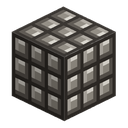
A heat source for the block directly above it only, and only once it is up to temperature. An LV consumer of EU/FE; it accepts energy on its available side faces. The glow changes with temperature — four steps from dark to red hot. The state is readable in the world without opening the screen. A fully warmed block lets heat break out of the seam with the machine. The particles only appear at full warm-up: they are the "×3 is running" signal, not a constant background. Mine with a pickaxe; it drops itself.
Sound
While the coils have any colour at all, the heater crackles with hot nichrome — the loop (pattern C, 0.18). It plays on every rung above cold and is silent only when the block is stone cold.
The window means "EU/FE is being spent", not "the coils are hot". The warm-up is audible and so is heat being handed to the machine above — exactly the states the player pays for. Two others are silent: holding temperature while the machine above waits, and the whole cool-down.
The light stayed on temperature and keeps burning while the coils are hot. The mismatch is deliberate: hot metal glows, which is physically honest, while a sound in this mod means "this is running". Until both followed one ladder, and a block whose founding promise is "a heater with nothing to heat costs exactly zero" hummed for twenty seconds after the work ended, and hummed indefinitely when power was cut with a machine still waiting above.
The hold itself is untouched and must stay: letting the heat decay would send the machine above back to asking for it, and the re-ramp burns a full warm-up on a loop that produces nothing.
Deliberately not a hiss: the Vulcanizer standing on top already hisses steam, and two hissing blocks in one stack would read as a single undifferentiated noise. The 0.18 volume is the quietest rung in the mod — this block is never listened to alone, the player always hears the pair.
Recipe
Crafted at a table from redstone dust, a gold ingot, iron ingots, M — a machine casing, E — an electronic circuit.
Links
Vulcanizer — the first heat consumer; the heat level multiplies its yield. Thermal Centrifuge — the second consumer. For it the heater is not the "best of the sources" but the only one: lava and campfires will not start it at all. Overclocker — it sits in the machine above, but the heater pays for it too. Lava and magma blocks give free level 2 with no warm-up at all; a campfire gives level 1. While the heater is lighting up, lava under the machine would already be working — that is the price of ×3.
Crafting
Shaped Crafting




▶
Electric Heater