
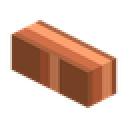
Copper Cable
alaindustrial:copper_cable
Summary
⚠️ Electrical safety: deals 2 damage not only on direct contact but also within 0.5 blocks of the segment — while the segment is live: energy is moving through it or its buffer holds a charge and a working generator is still on the grid . A charged dead-end spur carries no current precisely because it is already full — and that does not make it safe. A de-energised line is safe: with no live generator the leftover charge does not shock, so an open breaker still takes the hazard off everything past it. Normal armor applies; water does not amplify the hit; a solid block between the cable and the player blocks the shock. Servers can turn the mechanic off in the config. To lower the hit chance without removing the hazard, use an insulating stand — or replace the bare grade with the Insulated Copper Cable, which is safe outright. The damage can be removed outright without touching the line at all by the insulated set — leather armour dipped in slime: each worn piece cuts a quarter of the shock, a full set lets nothing through, and it spends durability doing so.
The Copper Cable is the main early-game cable and the wire of the starter chain: Solar Panel → Battery Box → Macerator. It connects neighbouring blocks into a single line and carries LV energy (up to 32 EU/FE/tick). On a long line some energy is lost along the way — the longer the wire and the higher the flow, the bigger the loss. Attenuation is exponential: a line of any length leaves at least 1 EU/FE from a positive packet, so the receiver's buffer always tops up to full. It is cheap to craft, which makes it handy for wiring a base before the higher-tier cables are unlocked.
Energy
The cable carries LV energy and connects to neighbouring blocks. Each wire run from a source to a consumer costs a little EU/FE — the exact formula is given in the table.
| Field | Value |
|---|---|
| Role | transfer |
| Max voltage | 32 (LV) |
| Loss | 0.02 attenuation per block; a consumer receives max(1, ceil(N × 0.98^distance)) EU/FE/tick when N > 0. Distance = number of cables from the nearest source |
| Insulation | can be insulated for safe adjacency |
| Stand | planks / wool / glass under a bare segment — lowers the shock chance, does not remove it |
The cable does not explode from overload: 32 EU/FE/packet is only a throughput cap, and anything above it simply does not pass through. A proper MV/HV/EV flow needs a cable of the matching tier.
Flow with inertia. A cable is not a teleport: every block has a small live buffer (12 EU/FE). All energy — to machines and to storage alike — moves segment by segment (cable → cable) in a single network pass per tick, so any working cable really holds and shows the energy passing through it, a distant consumer is reached only as fast as the line fills, and a broken line keeps the remainder in the buffers on the source side. The buffer is deliberately tiny: a grid of 1000 cables holds 12 × 1000 = 12 000 EU/FE — less than one Battery Box (20 000 EU/FE), so a "battery made of wire" is not a thing. Throughput equals the buffer: 12 EU/FE/tick into the cable next to the consumer (the tier voltage of 32 EU/FE caps what a source hands out, not what a thin line carries). Even with no consumer at all a source fills the wires to capacity, after which the network sleeps. The other grades of the ladder (tin/gold/electrum) are wired the same way, each through its own config keys.
Insulating stand. An already-laid bare segment can be given a stand: right-click the cable holding any wood (planks, logs, stripped), wool or glass of any colour to slip a thin plate underneath, and right-click with an empty hand to take it back off and recover the very same item. The plate shows the exact species or shade that was installed, and the stands of neighbouring segments meet flush along a run to form one continuous board.
The protection is directional, and that is the point of it. The plate sits under the wire, so a player walking past at floor level or standing underneath is shielded completely — no shock at all, neither on contact nor through the proximity radius. Only one case stays risky: climbing onto the cable, which puts the player above the plate, where it merely lowers the chance of a hit. Glass protects best, wood sits in the middle, wool is the weakest. When a stand absorbs a shock the player gets the same invulnerability window an ordinary hit would give, so the chance applies per contact instead of being re-rolled every tick.
Limits: a stand cannot go on an insulated grade (there is no hazard left to reduce, so it would be a decoration that does nothing) nor on a segment connected downwards, because that connection's sleeve fills the same space at the floor of the cell. If such a connection forms later, the stand is popped back out as an item. This does not get in the way of building with those blocks: sneaking with a block in hand is the vanilla way to bypass block interaction, so ordinary placement still works.
Block Properties
A thin wire that connects to neighbouring blocks. Any tool breaks it, and shears are especially handy.
| Field | Value |
|---|---|
| Shape | thin rod (6px core + sleeves), |
| Hardness | 0.2 |
| Tool | any / shears |
Connecting to slabs
The cable settles neatly onto the top of a slab-like neighbour (a solar panel, for instance): if the neighbour is a low block, the wire drops to meet it near the floor instead of hanging in mid-air. This works with any future low block automatically — no exceptions.
Cable Breaker
A clamp-on switch that de-energises a line for maintenance without tearing the wiring out. Right- click any laid cable with the breaker item to fit it; it appears as a small housing on top of the wire. Three gestures, no GUI: right-click with an empty hand throws the switch, sneak + right-click pries it back off, and the item is returned.
The state reads straight off the wire — a green band means the line is live, a red one means it is dead. The housing is a solid collar threaded onto the run; in a cell where the wiring leaves on more than one axis (a corner, a tee, the six-way star) it becomes a cube instead, because such a cell has no single axis for a collar to sit on. While the switch is open two short stubs poke out of the housing — severed ends, so the gap reads as a deliberate cut rather than a missing block. The click is pitched higher for on and lower for off, so the switch position is audible even when you are not looking at it.
An open breaker takes its own segment out of the grid entirely: the network splits in two exactly as if the cable had been mined, and everything downstream loses power. Bare wire past the breaker stops shocking within a tick — which is the whole point of the switch. Closing it puts the segment back the same way a freshly laid cable joins the grid.
A newly fitted breaker is closed, so installing one never blacks out a base by surprise, and removing one always restores the line whatever position the lever was left in. Breaking a cable drops its breaker (and its stand) as items rather than deleting them.
Manual only — the breaker does not read redstone. Throwing it rebuilds part of the grid, and a redstone clock would run that work several times a second; automation is a separate future task.
Recipes
Crafted at a workbench from copper alone — the most accessible wire for a starting base.
Crafting: 3 copper ingots in a row -> 3 cables. Processing recipes: none.
Related
Electrum Cable — the HV backbone with the ladder's lowest losses.
Crafting
Shaped Crafting
▶
×3Copper Cable
Used in
Shaped Crafting


▶
Battery
Shaped Crafting
▶

Battery Box
Shaped Crafting
▶
Charging Station
Shaped Crafting
▶
Copper Coil
Shaped Crafting

▶
 ×6
×6Insulated Copper Cable
Shaped Crafting
▶
Copper Conductor Tip
Shaped Crafting

▶
Lightning Rod Generator
Shaped Crafting


▶
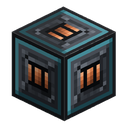 ×2
×2Reactor Outlet
Shaped Crafting
▶

Solar Panel
Shaped Crafting
▶
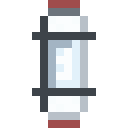
Vacuum Capsule
Shaped Crafting

▶
Water Mill
Shaped Crafting
▶
Wind Turbine
Shaped Crafting
▶

Wooden Rotor
Shaped Crafting



▶

Advanced Rotor