
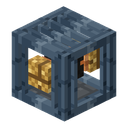
Town Road
alaindustrial:town_road
Summary
The Town Road is a full block laid flush with the ground: people walk on it as on any floor. It is a box of dark tempered iron with a grate on top, and inside, through the middle, runs a copper wire in rubber insulation. The wire is a real segment of the energy network: a road joins cables, machines and House Inlets exactly as a cable does. The town hall is the heart of the settlement and the roads are its veins: through them the energy of the Settlement Core reaches the shift workers' houses. While current flows through the wire, the lamp at the wire's hub is lit and the block itself glows faintly.
Quick example: order the restoration of a house in the core's "Construction" tab. The drone clears the site, lays a road from the settlement's road network to the socket of this house's inlet and rebuilds the house: the house is connected to the core. Break one road block in the middle, and the house's row shows "No link to the core: the road is broken at …" with the place of the break.
How it works
- A cable in a grate. Every road block is a cable segment with a live buffer, like the insulated copper cable. A road and a player's cable that touch are one line. The wire inside reaches its neighbours just as a cable's does: straight, a turn, a T, a cross, up and down.
- A building's connection. A house counts for the settlement only while its inlet is on one energy network with the core — through a road, through any cable of the player's, or both. A break cuts off everything beyond it: the road network builds no second way to the core, but you can close a ring with your own cable.
- The town hall's inlet is the core's outlet. The town hall has an inlet too, at its front. It offers the line the core's store: what comes into it charges the core, and the core gives the roads what it holds above its reserve for its own upkeep. The house inlets take this energy a little at a time — 8 EU/FE per tick per inlet.
- The settlement's road network. The settlement's roads are one tree, not a separate thread to every house. The main street runs from the town hall's inlet along the long side of the settlement, and streets branch off it at right angles to the buildings' inlets; every next building hooks onto the nearest point of the network that is already there. A street goes round buildings, water, trees and player blocks, does not lie on another house's doorstep, and prefers to follow the town's old paved streets — a road block replaces an old pavement slab. The network has no rings: from every cell there is one way to the town hall.
- Steps of one block at most. Neighbouring road blocks differ in height by one block at most, so that shift workers can walk and jump along them. Where the ground is uneven, the drone cuts away a bump (up to 3 blocks above the road) or fills a pit (up to 3 blocks below it) with earth or stone; a short bump or dip the road crosses at one level. On a step, one more road block lies under the upper road, hidden in the ground: the wire stays one line.
- At the inlet. The last cell before an inlet lies flush with the floor at the door. If the inlet's socket is one block higher, a "riser" stands above that cell: it has no frame, only the wire, which rises out of the grate of the road below and enters the inlet's socket.
- The drone lays the road. The road is a step of a building's order: clearing, road, building. The drone lays only the missing cells of the way from the building's inlet to the network (and the piece of the main street that is not there yet). The course is shown as ghosts by "Show the schematic" before the work starts; the "Settlement road network" row in the core's "Construction" tab shows the whole network at once. The drone takes the road blocks and the earth for the fill from the buffer of the Town Dispatcher, and the core pays EU/FE for every block placed or removed, as on any construction site. Grass, flowers, bushes and snow on the course the drone takes away by itself. A road or a cable a player has already laid it leaves alone — such a cell is already done. A player's block or a block with contents on the course is an obstacle: the work stops with the reason "Obstructed by …". If there is no way with steps of one block at most — the reason "No way for the road".
- Street reserve. The cells of the settlement's future streets are reserved: a new house cannot be laid over them ("In the way: a town street").
- The glow. The wire glows (light level 4) while energy has passed through the segment in the last second.
Energy
| Field | Value |
|---|---|
| Wire | insulated copper |
| Throughput (segment buffer) | 12 EU/FE/tick |
| Packet cap | 32 EU/FE (LV) |
| Loss | 0.01 per block — like the insulated copper cable |
| Electric shock | none: the wire is insulated |
Block Properties
| Field | Value |
|---|---|
| Shape | a full 16³ cube, walked on like a floor. The exception is the "riser" at an inlet: only a 6×6 wire, no frame |
| Look | a box frame of dark tempered iron with four bars on top across the wire; inside, the wire in rubber insulation, a brass coupling with a copper tip at every joint, a lamp at the hub (lit under current). If the wire goes down onto a step, the bottom is a grate too — the joint is visible from below. Two neighbouring roads are one channel: the walls between them are not drawn |
| Shade | casts no shade on the ground beside it, like glass |
| Light | 4 while current flows through the wire; otherwise 0 |
| Hardness and tool | pickaxe, hardness 2, blast resistance 6 |
| Drop | the road; the segment's charge is not kept in the item |
Recipes
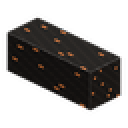
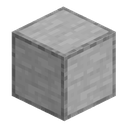
Town Road (crafting table), 3 pieces: three Tempered Iron Bars, three Insulated Copper Cables, three Smooth Stone.
| Row | Slots |
|---|---|
| 1 | Tempered Iron Bars ×3 |
| 2 | Insulated Copper Cable ×3 |
| 3 | Smooth Stone ×3 |
Progression
- Links a House Inlet with the town hall and the Settlement Core.
- Without a link to the core a house does not count and nobody lives in it.
Related
- Insulated Copper Cable — the same wire, without the grate.
- House Inlet — the end of the road at a house.
- Settlement Core — the heart of the settlement, the roads' energy source; the "Construction" tab.
- Town Dispatcher — the buffer the drone takes the road blocks from.
Crafting
Shaped Crafting

▶
×3Town Road