
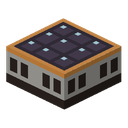
Mirror Concentrator
alaindustrial:radiant_solar_panel
Summary
The Mirror Concentrator is the third rung of the day branch, grown from the Daylight Solar Panel. It is twice as strong as that panel, and through the two midday hours of the game day it gives half as much again on top of that.
It is not flat like the two panels before it: the collector sits on a raised mast, with a mirror standing to either side to bring the light in to the centre. When there is nothing to collect — at night, in rain, in a thunderstorm or under snow — the mirrors swing up and fold over the collector, tucking the optics away. You can tell from a distance whether it is working or not.
A grown concentrator works on its own, but it looks like a large installation squeezed into a single block. Seven Solar Panel Sections placed around it assemble a two-by-two-by-two machine — the same one, at its proper size.
Mini-example: 8 EU/FE/t on a clear day, 12 at noon. Two of them on a roof keep a workshop running and fill a Battery Box by evening. The assembled machine gives the same — assembling is about the look, not the power.
Energy
| Field | Value |
|---|---|
| Role | producer with buffer |
| Buffer (EU/FE) | 16000 |
| Max input | n/a (does not accept energy) |
| Max output (EU/FE/t) | 20 (LV) |
| EU/FE/t (base) | 8 by day under open sky |
| EU/FE/t (noon) | 12 |
| EU/FE/t assembled | the same 8 and 12: assembling changes the size, not the tier |
The tier stays LV: even the 12 EU/FE/t at noon is far below the LV ceiling, so there is nothing to raise.
Generation
It works only in the Overworld, by day, with open sky above.
| Field | Value |
|---|---|
| Source | sunlight |
| Working condition | daytime AND open sky above the block |
| Dimensions | minecraft:overworld |
| Clear day | 8 |
| Noon | 12 |
| Through leaves | 4 (half of the current output) |
| Rain and thunder | 0 |
| Snow | 0 |
| Night | 0 |
Snow shuts it down completely — unlike the two panels below it, which keep a faint trickle under snow. The reason is in how it is built: those catch light with flat cells, while this one gathers it with mirrors, and a mirror buried in snow reflects nothing.
Noon is not a smooth curve but a window: two thousand ticks around the middle of the day. The number the player sees in the interface holds still for the whole of it.
Two-by-two-by-two assembly
The concentrator is drawn as a large installation but stands in a single block. Seven sections put that right: the machine grows into a two-by-two-by-two cube — four blocks below, four above.
How it is done. Put the grown concentrator where it is going to stand. Look at it, and a ghostly schematic of seven cells appears around it: that is what is left to deliver. Walk around the machine and the schematic hops to your side — you choose the direction by where you build, there is no button for it. Craft seven sections, place them on the schematic, and on the seventh the machine assembles itself, with no right-click and no command.
A cell with something already in it is outlined in amber instead of blue: that space is taken, and no section will go there.
What changes in the numbers: nothing. The assembled machine makes the same 8 EU/FE/t, and the same 12 at noon.
That is a decision, not a forgotten number. Assembling changes the SIZE, not the rung: the branch already steps 1, 4, 8, and a fourth rung hung off a building step would let a player skip the tier it belongs to.
So, plainly: a player who only wants energy is better off with four separate panels — on the same ground they would make four times as much. The seven sections buy the look and three saved resonance chips, not power.
Taking it apart. Break any one of the eight cells. The structure comes apart whole: the concentrator goes back to being a one-block machine and keeps working, the rest become ordinary sections again. Nothing is lost and nothing is duplicated; the buffer and its charge stay with the concentrator. One rule covers every way of breaking it — pickaxe, explosion, piston and command.
Connecting along the whole base. The machine has one buffer, and it lives in the concentrator itself — the block you grew it from. But you can connect to it anywhere along the bottom tier: a cable run to any side face or to the underside of the four bottom cells draws the concentrator's energy. The top tier, where the mirrors stand, takes no cable, and no arm is drawn towards it. However many cells touch the same line, it is one machine: it puts no more than one packet a tick into the line.
The bottom tier's housing sits back inside the block, so a cable meets it the way it meets an ordinary solar panel: the arm drops to the base and runs straight into the housing. The wire stays itself — a bare one bare, an insulated one insulated.
Interface
One screen shows the buffer level, the current output and the sky state. There is no chip slot: the concentrator is the top of the day branch, there is nowhere further to grow. On the assembled machine, a right-click on any of the eight cells opens it.
Block Properties
Neither a full block nor a slab: the body takes up almost the whole block in width and rises to three quarters of its height. The mirrors reach outside that shape deliberately — they fold, and a hitbox that travelled with them would change under the player's cursor while they were still moving.
| What | Value |
|---|---|
| Shape | body with a raised collector, 14×11×14 |
| Hardness / blast | 5.0 / 6.0 |
| Tool | pickaxe |
| Keeps its charge when broken | yes |
Sound
The same soft hum as the panels below it: it plays only while the concentrator is collecting light, and falls silent as the mirrors fold away.
Recipes
Not craftable. The only way to get one is to grow it from the Daylight Solar Panel: put a Resonance Chip into its slot and let the panel work through a few clear days. The stored energy carries over, the chip is consumed.
The Resonance Chip fills the whole crafting grid: a day alignment chip in the middle, and around it resonant shards, a spatial crystal, an energy crystal, reinforced electrum plates and silver gears. See evolution chips.
A Solar Panel Section is crafted the ordinary way, two at a time: four tempered iron plates in the corners, four glass at the edges and a machine casing in the middle. A full machine needs seven sections, which is four batches.
Progression
The third rung of the day branch. It grows out of the Daylight Solar Panel and is meant to grow on into the Zenith Solar Panel — that one is still a concept. The night branch's mirror at this rung is the Umbral Solar Panel, also still a concept.
Related
Daylight Solar Panel — the T2 it is grown from. Evolution chips — the Resonance Chip for this step. Solar Panel — the neutral T1, the root of the branch. Battery Box · Copper Cable
How to get it
Evolution~28 min of active output

▶
Mirror Concentrator