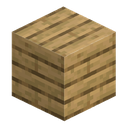
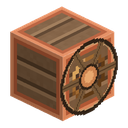
Water Mill
alaindustrial:water_mill
Summary
The Water Mill turns on flowing water and runs around the clock — night and storms mean nothing to it. No fuel, no tanks, no pumps: give it a current past the wheel and it produces EU/FE for as long as the water keeps moving.
Mini-example: a channel with a waterfall on either side of the wheel → 4 EU/FE/t, non-stop. Over one in-game day that is 96 000 EU/FE — eight times what a T1 solar panel makes in the same time (12 000 EU/FE, and only by day).
The one catch: still water does not count. Dropping the wheel into a pond or a river is not enough — it needs a real current.
Energy
The mill only produces power. Output leaves through the back face, which carries the connector; the other five faces are inert for energy.
| Field | Value |
|---|---|
| Internal buffer | 4000 EU/FE |
| Output | up to 32 EU/FE/t (LV) |
| Actual production | 0–4 EU/FE/t (1 per wheel side in a current) |
Generation
The wheel hangs one cell in front of the block, and water is counted around the wheel, not around the mill. The four working cells mirror how real water wheels are driven:
| Cell | What it is called |
|---|---|
| Below the wheel | undershot — the classic; the rim dips into the current |
| Above the wheel | overshot — water poured over the top |
| Left and right | the horizontal sweep of the rim |
Each cell with a current gives 1 EU/FE/t, all four give the maximum 4 EU/FE/t. The hub cell (directly in front of the mill) does not count: that is where the axle sits.
Only flowing or falling water counts. Rivers and oceans are made of source blocks, so "put it in a river" will not work. The reliable trick: place a source one cell above the wheel's cell — falling water never becomes a source. Pouring a bucket straight into the wheel's cell is useless, because that cell then becomes a source itself.
Room for the wheel
The wheel is large (rim about 2.7 blocks) and needs room to turn. All nine cells of the wheel's plane are checked — the front column and both neighbours, each on three levels, bottom row and diagonals included. A solid block in any of them hides the wheel and stops generation: the screen reads "Blocked". Water and passable blocks (grass, flowers, snow) do not obstruct it, so a channel around the wheel works fine. The check runs every tick: remove the block and the wheel is back.
Several mills together
If two wheels overlap in space, both mills stop with the status "Wheel interference".
| Arrangement | Gap needed |
|---|---|
| Side by side | 2 empty blocks |
| Face to face | 2 empty blocks |
| Back to back | flush is fine |
A neighbour without a wheel causes no trouble — but put a wheel in it and the working mill beside it stops too.
Inventory
One slot for the water wheel and four upgrade slots. Without a wheel the mill produces nothing and the external model is not drawn.
The wheel is a consumable. It only wears while the mill is actually producing EU/FE (no current or an obstruction means no wear) and in proportion to output. A full wheel is worth 320 000 EU/FE: about an hour of non-stop work at maximum, or 6–7 in-game days at a typical 2 EU/FE/t. When it runs out the wheel breaks with a sound and generation stops until a new one is fitted. A worn wheel need not be thrown away: the component repair bench clears the wear for one item and some EU/FE, at the cost of a lower durability ceiling — and no more than four times.
Interface
Energy bar on the left, wheel slot in the centre, indicator on the right: a white wheel means idle, blue means working. The line under the slot shows either the current output or the reason it stopped: "Wheel interference", "Blocked", "No water" or "No wheel".
The line is never empty. A mill with no wheel used to say nothing, on the reasoning that the empty slot spoke for itself. In practice the player saw a working-looking screen producing nothing and got no hint at all. It is now a state of its own with its own line, like the Wind Turbine's "No rotor".
Block Properties
An ordinary full block, broken with any pickaxe.
| Field | Value |
|---|---|
| Shape | full cube |
| Hardness | 3.0 |
| Blast resistance | 6.0 |
| Tool | pickaxe |
Visual
A large open wheel turns in front of the mill: two 24-segment oak rims, eight spokes on each side, twelve buckets between the rims, a wooden hub and a copper axle. The stronger the current, the faster it spins; with no current the wheel stands still.
Sound
While the wheel turns you hear a quiet splash of water within about 12 blocks. It falls silent when the wheel stops.
Recipes
Crafted at a workbench from planks, copper ingots, a copper cable and a wooden gear. The water wheel is crafted separately — the mill does not work without it.
Related
Solar Panel — the other passive source, but it depends on the sky and the time of day. Generator — twice the output, but it needs fuel. Water Wheel — the consumable the mill cannot run without.
Crafting
Shaped Crafting



▶
Water Mill