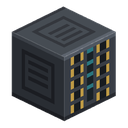
Monitor Core
Summary
The Monitoring Wall is a warehouse dashboard: a row of panels by your base entrance showing how much of each item is in your chests, without opening any of them. It is three blocks and one item:
Monitor Core — the brain: it takes power from a cable, holds a rack of 10 cards, and hands the panels their numbers. Without a core the wall does nothing. Smart Wire — a line that reads containers instead of carrying goods: run it from the core to chests, barrels, shulkers and the mod's own chests. Monitor Panel — the screen. Panels placed against each other and against the core join into one system, in any shape: a wall can turn a corner or wrap a pillar. Capacity Card — fitted into the core, it raises how many different item types the system tracks at once.
Mini-example: run a smart wire from the core to your ore chest, place a panel next to the core and right-click a diamond into it → the panel shows how many diamonds are in the wired chests.
How it works
One item type per panel. To watch more types, build more panels. Once a second the core walks the wired containers once for the whole wall and hands out the numbers, so a big wall costs the server no more than a small one — it costs more only in energy. Only top-level slots are counted; the system does not dig into shulkers inside chests — the same rule the Stock Display Frame keeps. A double chest counts as one container. A container whose loot has not been generated yet is not read at all: looking inside would unpack its loot table with no player in context and empty somebody else's chest for good.
Energy and capacity
Upkeep: a base cost at the core plus a surcharge for every panel actually showing a number. An empty panel costs nothing. Card capacity limits the number of types, not of panels: two panels watching the same item take one slot of capacity. When capacity runs out, the same panels always go dark (the order is geometric and does not change across world reloads), never random ones.
What a panel shows
| Mark | Meaning |
|---|---|
| A number | all is well: that much of the item sits in the wired chests |
grey ? | this part of the wall has no core — the wall was broken apart |
red ! | the core cannot pay for the wall |
amber x | not enough card capacity |
Number format: exact up to 10,000, then 12.3k and 1.2M. The text is legible from 24 blocks.
Interface
None of these blocks has a screen.
Right-click a panel holding an item → the item becomes the filter. Right-click a panel empty-handed → the filter comes back. Right-click the core holding a capacity card → the card goes into the first free slot. Right-click the core empty-handed → the last fitted card comes back.
Block properties
| Block | Shape and collision | Strength | Tool |
|---|---|---|---|
| Monitor Core | full cube, front face is the card rack | 3.0 / 6.0 | pickaxe |
| Monitor Panel | full cube, front face is the screen | 2.0 / 4.0 | pickaxe |
| Smart Wire | slim 4×4×4 core plus an arm toward each connection | 0.2 / 0.5 | pickaxe |
The core and the panel face the player when placed. Power enters the core through any face but the front — a cable never draws an arm across the screen the player is meant to read. Panels and the wire take no energy at all.
What this is not: Applied Energistics
The system only ever looks. Items stay physically in the player's chests: they cannot be withdrawn remotely, cannot be inserted through the network, take no part in crafting and are never stored as a digital copy. A capacity card is the right to watch a few more types, never a place to keep one.
Limits of the current version
The system is hidden from players for now (owner's decision, 2026-09-09). The blocks and the card are registered and working, but they have no recipes and no creative-tab entry — only a give command produces them. They open up once the looks and the balance are finished.
Exactly one core per system: a second core in the same connected wall stops it entirely. The card has a single tier; a tier ladder and a second axis (wire reach) are open questions in. Balance (upkeep, capacity, scan interval) is configurable and will be tuned from play.