
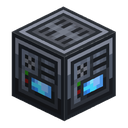
Workstation
alaindustrial:workstation
Summary
The Workstation is a two-block machine you assemble yourself: craft two identical casings, stack one on the other, and they turn into a computer with monitors. Taking it apart is just as simple — break either half and the survivor becomes a casing again, so you always get back exactly as many casings as you put in.
The station connects to the grid as an ordinary consumer. While there is energy in the buffer the screens are lit; an empty station stands dark. A right-click answers in one chat line: whether it is assembled, and how much energy the buffer holds.
Quick example: craft two casings, put one on top of the other — you will hear the assembly click — run an MV cable into the side of the lower half and watch the screens come up.
The recipe sits at the end of the tech tree. A single craft yields both casings, that is exactly one station: a resonant crystal (charged, the top of the crystal chain), a reactor circuit, two resonance coils, two reinforced bearings, an advanced machine casing and two glass panes for the screens. Every component is one step above what an ordinary machine takes; the station is not meant to show up for a player who has not built a reactor and grown crystals yet.
Assembly
Only a vertical pair assembles: a casing on a casing. There are exactly three rules, and all
- Place a casing — if there is a casing below it, the pair forms and the lower one becomes the
base. If there is none below but there is one above, the pair forms upward.
- The facing comes from the lower half. The base is the machine, and people build upward.
- A stack of three resolves predictably: the pair forms from the bottom two, the third stays a
casing.
Losing a half — by pickaxe, explosion, piston or command — turns the surviving half back into a casing. There is no separate "disassemble", and none is needed.
Energy
| Parameter | Value | Config key |
|---|---|---|
| Tier | MV | |
| Buffer | 40000 EU/FE | |
| Intake from the grid | 128 EU/FE/t | |
| Output | 0 (pure consumer) | — |
| Upkeep while running | 6 EU/FE/t | |
| Learning one skill | 30000 EU/FE |
Energy goes into the lower half only, and only through its side and back faces: the front — the one the player looks at — is inert, so a cable never draws an arm across the screens. A loose casing and the upper half take no energy at all, and a cable will not connect to them.
The station is declared a store rather than a machine: on a shared grid it is served after the working machines. Otherwise its 128 EU/FE/t request would starve the LV machines on the same cable.
The station draws power just by standing there. Six EU/FE/t is little against an MV line, but enough that an abandoned base goes dark: with no charge the screen will not open, the fans stop and the monitors fold away.
It is charged for the ticks that actually elapsed, at most a second's worth per debit. An unpowered station visits its tick once a second and pays in one-second lumps; a station on a live cable is woken by every delivery and pays a tick at a time — the rate is the same either way. A fixed batch per visit would not be the same thing: the sleep is a request rather than a promise, and a powered station enters its tick every tick.
Learning costs 30000 EU/FE per node, whatever its depth. The price in Ala-Fragments already grows with the row (1 / 2 / 3 / 4 / 8), and charging more energy for a deeper node would price the same decision twice. Against a 40000 EU/FE buffer that is most of a full charge: learning is an event the base has to be ready for, not background noise.
Block properties
Shape. A casing is a full 16×16×16 cube and behaves like an ordinary solid block. The assembled machine occupies two cells: the lower half is a cabinet at full height (depth 0.5…15.5), the upper one is a stand carrying the monitor block. The monitor wings stick out past the block by about 4 pixels on each side. They are visible but not clickable: collision outside the cell misbehaves, so the silhouette ends at the block boundary. A neighbouring block placed flush against it will cover the wings. Hardness 3.0, blast resistance 6.0, metal sounds; mined with a pickaxe. A piston will not move the station — otherwise one half would ride away and the other would be left standing as a casing.
Recipes
One craft at the workbench gives two casings — exactly the set for one station. That is deliberate: the halves are placed as a pair, and paying twice would mean asking for two resonant crystals for a single computer.
| What | From what |
|---|---|
| Workstation (2 casings) | 1 × resonant crystal (charged), 1 × reactor circuit, 2 × resonance coil, 2 × reinforced bearing, 1 × advanced machine casing, 2 × glass panes |
Every component is one step above what an ordinary machine takes: not an energy crystal but a resonant one (the top of the chain: energy crystal → lapotron → resonant); not a copper coil but a resonance coil; not an advanced circuit but a reactor circuit; not a basic bearing but a reinforced one. The crystal has to be charged — the same order the lapotron and resonant blanks follow, where the next step's recipe takes the previous step's charged crystal.
Progression
The station is the end of the tech tree, not the entrance to MV. Through the resonant crystal it inherits the crystal greenhouse (spatial crystals and resonant shards) and energy clots III; through the reactor circuit, the nuclear branch (palladium); through the reinforced bearings, the mechanical one (reinforced bronze plates, basic bearings, electrum gears); through the advanced casing, the oil branch (rubber). No order of progression lets you build it before a reactor stands and crystals grow — and that is deliberate: permanent bonuses for the player come from the machine you finish the mod for.
Related
Player Profile — the career statistics and mastery levels the station draws Ala-Fragments from: one per earned level (the starting first one does not count), which is 39 by level forty against 72 for the whole tree.
Crafting
Shaped Crafting
glass
glass



▶
×2Workstation