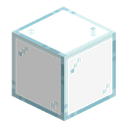

Incubator
alaindustrial:incubator
Summary
The Incubator is a 1×2 multiblock: a squat mechanical base below and a glass dome above. Place any glass (the c:glass tag) on the base and it turns into a volumetric chamber, with the irradiated item floating and spinning inside.
The machine mutates items in three ways: it duplicates (1 → 2), transforms (A → B), or creates a new mod material. Every operation costs EU/FE (LV) and an irradiation charge: one uranium_ingot buys 3 attempts, then burns out into depleted_uranium which settles in the ash slot.
The mode by a mutation chip in a dedicated slot — duplication / transformation / creation. Without a chip the machine does not run; the chip itself is never consumed. The outcome is probabilistic: on success a rarity grade is rolled — Common (70 %) / Rare (20 %) / Epic (8 %) / Legendary (2 %) — which colors the name and grants a bonus to further mutations.
| What it does | How |
|---|---|
| Forms the multiblock | base + any c:glass block on top → dome |
| Mutates items | EU/FE (LV) + a charge (1 uranium_ingot = 3 attempts → 1 depleted_uranium) |
| Mode | chip slot: duplication / transformation / creation |
| Mutation kinds | duplicate (×2), transform (A→B), create (A→new mod item) |
| Rarity | every success rolls Common / Rare / Epic / Legendary (70/20/8/2 %) |
| Slag | 5 % of attempts yield irradiated_slag instead of an empty failure |
Energy
Hybrid model: EU/FE from the grid (LV) plus uranium as the irradiation fuel. Uranium is not destroyed — it becomes depleted_uranium, a feedstock for the future nuclear phase.
| Field | Value |
|---|---|
| EU/FE buffer | 8000 — holds the costliest create operation in full |
| Max input | 32 EU/FE/tick (LV) |
| Consumption | 8 EU/FE/tick while running — four times the machine standard |
| Fuel | 1 uranium_ingot = 3 attempts → 1 depleted_uranium into the ash slot |
Without uranium in the fuel slot an operation will not start; EU/FE is spent only while a cycle runs.
Processing
Duration and cost are tied to the mutation kind. The Incubator is the mod's most energy-hungry LV machine: the floor is 2400 EU/FE per operation versus 200–300 for routine machines.
| Kind | Success chance | Ticks | EU/FE/attempt | On failure |
|---|---|---|---|---|
| Transform | 0.75 | 300 (15 s) | 2400 | input lost, −1 charge |
| Duplicate | 0.45 | 500 (25 s) | 4000 | input lost, −1 charge |
| Create | 0.25 | 1000 (50 s) | 8000 | input lost, −1 charge |
Three outcomes of an attempt:
| Outcome | Probability | What happens |
|---|---|---|
| Success | chance by kind (+ gene bonus, cap 0.95) | result into the output slot + a grade roll |
| Slag | 5 % | input lost, irradiated_slag drops into the output |
| Failure | the remainder | input lost, output unchanged |
Slag is subtracted from the failure, never from the success — the success chance never drops. A grade is rolled only on success (slag is always Common). The outcome is rolled at the end of the cycle: until the last tick the result is unknown and cannot be cancelled by pulling the input.
Grade. On success a rarity is rolled: Common 70 % / Rare 20 % / Epic 8 % / Legendary 2 %. A Common grade leaves no trace — the item still stacks with vanilla. Rare and above write the mutation_grade component and color the name (yellow / aqua / light purple).
The input gene burns. The input item's grade grants its chance bonus (+5 / +10 / +15 p.p. for Rare / Epic / Legendary, the total capped at 0.95) and burns away — the result always gets a fresh grade roll. A Legendary cannot be multiplied via duplicate; it can only be spent for the higher chance.
The nutrient bath (water). The incubator holds an eight-bucket tank and draws 1000 mB per attempt. Water is not required: without it the machine runs exactly as it did before, so an incubator already standing in a world does not stop the day the player updates the mod. With water an attempt runs 50 % faster — a duplicate takes 333 ticks instead of 500. Fill it with a fluid pipe from any side, or with a bucket in hand (right-click the block; for everything else you might be holding the menu opens as before). The water never comes back out. The price is taken once, at the start of an attempt, and that attempt keeps the length it bought even if the tank runs dry. The water itself stands in the glass chamber — the nutrient bath the item is irradiated under — and rises with the tank. The same level reads from outside on a sight glass at the back, beside the inlet, with no menu open.
Inventory
Five slots: chip, fuel (uranium), the item to mutate, the result, and ash. The result and ash slots are read-only for the player; automation into the ash slot is pull-only.
| Slot | Accepts | Behaviour |
|---|---|---|
| Chip | # (3 chips) | 1 item; not consumed; sets the mode; an empty slot means the machine will not run; automation cannot take it out |
| Fuel | # (= uranium_ingot) | 1 ingot is taken the moment it lands in an assembled machine; a charge = 3 attempts |
| Input | items with a mutation recipe in the selected mode | 1 stack; consumes 1/attempt (lost on failure) |
| Result | the mutation result or irradiated_slag | 1 stack; fill-only |
| Ash | depleted_uranium | 1 stack; +1 per exhausted ingot; pull-only |
Interface
The screen shows: EU/FE storage, cycle progress, the irradiation charge (0–3), the five slots and a formed indicator. The energy bar runs down the left edge; the irradiation charge is a vertical column of pips right of the fuel slot, filling from the bottom up. Top row: chip, input, progress arrow, result; bottom row: fuel and ash.
The chip slot is the top left one. While it is empty, the status line names what is missing ("Needs glass on top" → "Needs a chip") and the slot itself shows a translucent hint item: the three chips take turns, because any of them fits and a frozen picture of one would read as "only this one works". The fuel slot hints the uranium ingot the same way, with nothing to cycle — the fuel tag holds only that. Swapping the chip resets the progress of the current operation.
Both halves of the multiblock are clickable: right-clicking the dome opens the same menu as clicking the base.
Block Properties
A two-tier multiblock with deliberately different silhouettes: a heavy mechanical bottom and a light glass chamber on top — not "two cubes stacked on each other".
Base — a 51-element technical plinth: a screen and a cartridge on the working face, vents on the sides, and a middle band recessed by half a pixel between a full-width foot and cornice. From the outside it is still a full 16³ cube: the collision is full, the block occludes its neighbours and dampens light completely. The recessed bands are grooves rather than openings, and full-width bands seal them above and below, so occluding a neighbour exposes nothing to the eye. On the back sit the nutrient bath's inlet and a sight glass beside it: the water level reads from outside, with no menu open. Dome — a see-through chamber with no thick cross rib: a glass barrel, two stepped shoulders and a compact lid. Not a full cube, hence; its shape and collision step inward with the silhouette (five boxes, generated from the model). Placed automatically from any c:glass block. The original glass type is remembered, so: dismantling the multiblock returns exactly your glass — nothing is lost; stained glass tints the dome — 17 colors with no extra recipes: 16 stained-glass dyes plus an uncolored variant. The frame and the lid's metal cap always stay the casing's dark metal (the thin glass plate under that cap tints along with the barrel). The irradiated item floats at the center of the chamber and slowly spins; while running — particles, a pulsing glow and an emitter ring turning above the chamber floor.
Sound
While running, the incubator gurgles with the nutrient bath under its dome — the loop (pattern A, default 0.35). It falls silent when idle. The gurgle was picked over Geiger ticking out of ten candidates: the irradiation is the method here, not the point, so the machine should sound like something growing rather than like a hazard
Recipes
Base block follows the machine-assembly standard, full 3×3 grid: 1 machine casing + 2 uranium plates + 3 glass + 1 electronic circuit + 2 iron plates. The uranium plates gate entry into the mechanic behind an established uranium chain (ore → ingot → plate).
The three mode chips are crafted from empty_chip plus a thematic filling; a uranium plate in each is the shared "irradiating" element:
| Chip | Recipe | Mode |
|---|---|---|
mutation_chip_duplicate | empty chip + 2 amethyst shards + uranium plate | duplicate |
mutation_chip_transform | empty chip + redstone + lapis + uranium plate | transform |
mutation_chip_create | empty chip + diamond + echo shard + uranium plate | create |
Recipe type — three separate types, one per mode: mutation_transform, mutation_duplicate, mutation_create. Each JSON describes one input → one output with an optional chance override. Fuel is not mentioned in the recipe — uranium is the machine's charge, not an ingredient.
Duplicate — four value classes
The cost of an attempt is fixed (⅓ of an ingot + 4000 EU/FE + 25 s), so the only balance lever is the success chance: the more valuable the item, the lower the chance.
| Class | Chance | Items |
|---|---|---|
| Gems and precious ingots | 0.45 | diamond, emerald, amethyst_shard, gold_ingot, silver_ingot, nickel_ingot |
| Minerals and common ingots | 0.55 | coal, redstone, lapis_lazuli, quartz, glowstone_dust, iron_ingot, copper_ingot, tin_ingot, raw_rubber, rubber |
| Rare organics | 0.60 | nether_wart, cocoa_beans, glow_berries, torchflower_seeds, pitcher_pod |
| Basic crops | 0.85 | wheat_seeds, beetroot_seeds, melon_seeds, pumpkin_seeds, carrot, potato |
Ingots yes, processed parts no. Vanilla and mod ingots are duplicated (iron, copper, gold, tin, silver, nickel) — these are base materials. Anything processed (dusts, plates, casings, circuits, chips, cables, raw ore and ore blocks) is not — it would devalue the crafting chain. Uranium is not duplicated (no recipe).
Rubber is a stated exception. It is a machine product, so by the rule above it should not duplicate. But oil is a finite resource — lakes do not refill and nothing turns water into oil — so without the Incubator the amount of rubber in a world is capped by the deposits you happen to find. Duplication is an expensive renewable route, not a free one: an attempt costs 4000 EU/FE and a third of a uranium ingot at a 0.55 chance, while the same rubber made from fresh oil costs 400 EU/FE. While there is oil left, pumping is ten times cheaper; the Incubator matters once there is not.
. With kok sagyz rubber now has a primary renewable route — the plantation: a root macerates into raw_rubber for 300 EU/FE per unit plus a cheap vulcanization, roughly 700 EU/FE per rubber against ~7273 EU/FE here. The role of incubator duplication is narrowed down to an emergency: uranium already mined, oil gone, no seeds. The duplication numbers are unchanged.
Transform — a horizontal exchange
Like is traded for like. Upgrading by value (iron → gold) is forbidden. All 27 recipes share a 0.75 chance, 300-tick duration and 2400 EU/FE cost. For families with many members (saplings, flowers, soils) a ring is used: each item turns into the next one around the circle until the wanted one comes up.
| Category | Recipes | Ring |
|---|---|---|
| Minerals | 3 | lapis_lazuli ↔ redstone, quartz ↔ glowstone_dust, coal ↔ charcoal (all 1:1) |
| Saplings | 8 | oak → birch → spruce → jungle → acacia → dark oak → cherry → mangrove → oak |
| Flowers | 8 | dandelion → poppy → blue orchid → allium → azure bluet → cornflower → lily of the valley → oxeye daisy → dandelion |
| Soils | 5 | dirt → podzol → mycelium → dirt; sand ↔ red sand |
Create — evolution ladders
An ordinary item evolves into a unique mod material along a three-tier ladder. The higher the tier, the lower the chance and the costlier the operation. From tier 2 onward a failure returns the input intact (only the charge and EU/FE burn) — otherwise no one would risk climbing past tier 1.
| Branch | Tier 1 | Tier 2 | Tier 3 |
|---|---|---|---|
| Diamond — energy density | diamond → irradiated diamond | → diamond matrix | → singularity core |
| Crystal — optics | amethyst_shard → resonant shard | → focusing lens | → prismatic core |
| Biological — agriculture | lapis_lazuli → mutagen dust | → living mutagen | → gene matrix |
| Nuclear — fuel | depleted_uranium → unstable isotope | → enriched core | → isotope concentrate |
| Tier | Chance | Ticks | EU/FE | On failure |
|---|---|---|---|---|
| 1 (vanilla → mod material) | 0.25 | 1000 | 8000 | input is lost |
| 2 | 0.15 | 1500 | 12000 | input returned intact |
| 3 | 0.08 | 2000 | 16000 | input returned intact |
The nuclear branch starts from the Incubator's own ash — spent uranium becomes the entry to a chain rather than waste.
The current release ships only the 4 tier-1 recipes (one per branch): diamond → irradiated_diamond, amethyst_shard → resonant_shard, lapis_lazuli → mutagen_dust, depleted_uranium → unstable_isotope. Tiers 2–3 and upgrade chips from the upper materials come in the next release.
Progression
Tier: LV. Best built after the first machines (macerator/extractor), once you have a stable uranium vein and an EU/FE grid. Introduces 7 new items: depleted_uranium, irradiated_diamond, mutagen_dust, resonant_shard, unstable_isotope, irradiated_slag (a by-product of 5 % of attempts — no consumers in this release, groundwork for the future) and three mode chips. Grade "genes" on materials grant a bonus to further mutation chances (+5/+10/+15 p.p.) — consumers will arrive in future agriculture/nuclear phases. Mutation advancements: first mutation, first create result, first Legendary outcome.
Related
Uranium — the fuel ingot. Nuclear theme — where depleted_uranium goes. Teleporter multiblock — a sibling structural task. Sawmill — the reference machine with switchable modes. Solar panel — the reference for a chip slot driving machine behaviour.
Crafting
Shaped Crafting

▶
Incubator