Reception Capsule
Summary
The Reception Capsule is where the archive brings the settlement's residents back. For energy and materials it restores one shift worker at a time: a former record of this world that has no name, only a number on its back. In look and in meaning it is a relative of the Teleporter's capsule: the archive brings a record back.
The capsule closes the path through a work town: find the town → power the Settlement Core → restore the town hall and a house → bring back the first shift worker. Each shift worker needs a house of its own: without a free house fit to live in, the capsule does not release a new worker.
Quick example: the core in the town hall is lit, the settlement is yours, and the drones have restored the town hall and the first capsule house. Run an LV cable to the lower part of the capsule, put in 1 Electronic Circuit, 8 Rubber and 4 Copper Plates and wait until the capsule has gathered 100 000 EU/FE. After one in-game day of restoring (≈20 minutes) a shift worker with a number on its back, for example W-117, appears on the floor of the flask and moves into the free house straight away.
How it works
- Its own settlement. The capsule finds by itself the settlement whose territory it stands on; if the territories of two settlements overlap, it takes the one whose core is closer. While the capsule stands, its settlement does not change.
- Conditions. The capsule works only if its settlement's core is in place and lit, the capsule itself is on that territory, the settlement has a restorer, there are fewer living shift workers than the limit (4 at LV) and there is a free house fit to live in for the new worker — a capsule house the settlement has counted (see the Settlement Core, "Shift workers' houses"). Without such a house the capsule stands with the reason "No housing: no free house fit to live in", and if there are no fit houses at all — "No homes: restore or build a house". A dead worker being brought back needs no free house: it keeps its own house while it waits to be brought back.
- Price. The capsule gathers EU/FE in its buffer and holds the materials in three slots; each slot takes only its own material — by hand, from a hopper or through a pipe. Once everything is in, restoring begins: one in-game day — 24 000 ticks, about 20 minutes. From the very first tick the bar and the status line show at least 1 %, so you can see the process has started.
- Result. At the end of restoring exactly one shift worker appears in the flask — on the floor, facing out — and only after that does the capsule take the price: the EU/FE and the materials at once. The new worker moves into a free house straight away. A worker's number looks like
<letter>-<three digits>and is never repeated anywhere in the world; the worker's look depends on the number too. - A refusal takes nothing. No core, the core taken away or dark, the capsule outside the territory, no restorer, the settlement full, no free house, not enough materials or EU/FE, the archive failing to place the worker in the world — the materials and the gathered energy stay in the capsule. The capsule's window names the reason in a line.
- Progress is not lost. If the core goes dark in the middle of restoring, the bar freezes; once the core is lit again, restoring carries on from the same spot. If the archive does not answer (the worker could not be placed in the world), the bar resets, and the capsule waits one restoring before it tries again.
- Only its own (R98). Only the restorer of a woken settlement opens the capsule's window. A stranger gets no window and reads in the chat "The core does not recognise you: you are not part of this settlement." An operator in creative mode opens the window, but the slots and the choice of worker do not obey them.
Bringing back the dead
A dead shift worker's number is never handed to a new one. By default a shift worker's death is final. If the server turns that off, a dead worker waits to be brought back, and the capsule offers a choice: a button in the window cycles "New worker" → the settlement's dead by number → "New worker" again.
- The worker brought back is the same shift worker: the same number and the same look, in a new body. They come back with a full battery and full health, but one level lower (never below the first) and without the last point invested in their stats; their personal file gets a mark that they were brought back.
- Bringing one back costs twice as much as a new one: 200 000 EU/FE, 2 circuits, 16 rubber, 8 copper plates. The capsule's buffer holds exactly the price of bringing one back.
- If a shift worker's death is final, a dead worker does not wait to be brought back, and there is no choice.
Resetting a worker's points
The capsule is also where a shift worker's stats get redistributed. When a living worker of the settlement stands no more than 3 blocks from a capsule of its settlement, the settlement's restorer sees a "Reset points (50 000 EU/FE)" button on the worker's card. It turns all invested points back into free ones, ready to be invested again. The price is taken from the capsule's buffer, so the button only shows when the buffer holds 50 000 EU/FE and the worker has at least one invested point. The card and the points are described on the Settlement Core page, section "The settlement's shift workers".
When the settlement sleeps
The settlement falls asleep because of the core, not the capsule: when the core goes dark, the settlement's shift workers keep working on their batteries while there is charge in them, then freeze where they stood and do not die from it; when the power comes back, the core recharges them and they carry on from the same spot. While the core is dark, the capsule stands still too: a restoring in progress freezes and later carries on from the same spot, losing nothing.
Energy
| Field | Value |
|---|---|
| Role | consumer that gathers energy in a buffer |
| Tier / grid intake | LV, up to 32 EU/FE per tick; a cable connects to the lower part of the capsule, on any side except the open front |
| Buffer | 200 000 EU/FE — exactly the price of bringing back a dead worker |
| EU/FE per shift worker | 100 000 EU/FE (bringing one back — 200 000) |
| Restoring time | 24 000 ticks (one in-game day, ≈20 min) |
On a full LV packet (32 EU/FE per tick) 100 000 EU/FE take 3125 ticks to gather — about 156 seconds. From one fuel generator (8 EU/FE per tick) it takes 12 500 ticks, about 10.4 minutes, and meanwhile the settlement's core spends its own 8 EU/FE per tick. So the first shift worker needs several generators or a stored reserve.
Inventory
| Slot | Takes | How many per shift worker |
|---|---|---|
| 1 | Electronic Circuit | 1 (bringing one back — 2) |
| 2 | Rubber | 8 (bringing one back — 16) |
| 3 | Copper Plate | 4 (bringing one back — 8) |
This is not a recipe but a price: the materials sit in the capsule until it is time to take them. The circuit is the electronics of the shift worker's work suit, the rubber is the overall itself, the copper is the helmet's parts and the battery on the back. All of it is made before MV machines.
Interface
- A window taller than usual: a header, a bar, three rows of materials and the player's inventory at the bottom.
- The header holds a 3D shift worker head, "Shift workers: N / M" and "EU/FE: X more" or "EU/FE: ready". M is how many shift workers the settlement can house: the number of houses fit to live in, but no more than the tier's limit. While there are no fit houses, the line is red: "Shift workers: N, no homes". An old world may have more shift workers than houses — the line shows both numbers as they are.
- Under the header is the choice "New worker" / "Bring back W-117 (×2)" (the button appears only when there is someone to bring back) and the restoring bar across the whole width of the window.
- The materials take a row each: the slot, the item's name and "have/need" on the right (in red while it is short). The energy bar sits to the left of the rows.
- At the bottom is the reason for a refusal or "Restoring: N%". The reasons: "No settlement core around", "The settlement's core is taken away", "Outside the settlement's territory", "The settlement core has no power", "No restorer yet: open the powered core", "The settlement is full", "No housing: no free house fit to live in" (or "No homes: restore or build a house"), "Not enough materials", "Not enough EU/FE", "The archive does not answer".
Block Properties
| Field | Value |
|---|---|
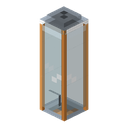
| Shape | a glass flask three blocks tall, open at the front: a steel floor, corner posts and walls at the bottom, and on top a roof with an emitter and a cap. A shift worker as tall as a player stands inside it whole. The flask is see-through and does not hide neighbouring blocks |
| Collision | the posts, walls, thin floor, roof and cap follow the model; inside there is room for one shift worker, who can walk out at the front |
| Placing | faces the player; the spot needs two free cells above it. Breaking any of the three parts removes the whole capsule |
| Window | a click on any part of the flask opens the capsule's window |
| Hardness and tool | unbreakable, like bedrock, and immune to explosions; the settlement's restorer breaks it with any pickaxe, like a block of hardness 5 |
| Piston | cannot be pushed |
| Drop | exactly one capsule plus the materials from its slots. Without a capsule the settlement takes no new shift workers; everything else keeps working |
| Where it stands | in the town hall of every work town: empty, three cells west of the core, with its open side facing the core; also in the creative tab |
Recipes
The capsule has no recipe: it already stands in the town hall of every work town, and it can also be taken from the creative tab.
Progression
- Needs a lit Settlement Core of its own settlement, a restorer for that settlement and a free house fit to live in for each new shift worker.
- Gives shift workers — one at a time, up to the settlement's limit (4 at LV) and no more than there are fit houses.
Related
- Settlement Core — the capsule does not work without it.
- House Inlet and Charging Bed — without them a house is not fit to live in.
- Teleporter — the teleporter's capsule, a relative in looks.