

Reactor Casing
alaindustrial:reactor_casing
Summary
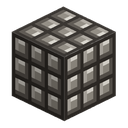
Reactor Casing is the wall, floor and ceiling of a reactor room. It is neither a decorative block nor "reinforced stone": a Nuclear Reactor room is not a single block with a grid of slots but a building you actually put up, and the casing is what you put it up out of. Plain stone, an iron block and vanilla glass all read to the room scanner exactly as air does — a hole.
What the shell is made of
The shell is the six faces of an axis-aligned box. Every one of its cells must be one of seven blocks; any other block, and any air, is a breach:
| Block | Role in the shell | How many |
|---|---|---|
| Reactor Casing | wall / floor / ceiling | everything else |
| Reactor Lamp | light from the inside; to the scanner, plain casing | any number, zero included |
| Reactor Glass | a window that is still wall | at most (30 %) of the shell |
| Airlock Door | the only way in | at least one |
| Reactor Inlet | where a pipe crosses the wall: water in, steam out | any number, zero included |
| Reactor Outlet | the socket a cable plugs into; casing as far as the scan is concerned | any number, zero included |
| Controller | the room's brain | exactly one, vertical wall only |
The casing is the only one of the seven with no conditions of its own: it fits any cell of any face, including the edges and corners that are off limits to the door and the controller. The lamp inherits exactly those properties — the scanner classifies it as casing — and therefore does not count against the glass cap: lighting a room is not the same as spending its window budget.
The reactor button stands apart: it is not part of the shell and occupies no cell — it hangs on a wall from the inside and exists only to send a pulse to the door. Putting it where a shell block belongs does not work; the scanner reads that cell as a breach.
Room size
The limits are on the interior — what the player walks into, not the footprint of the build:
| Field | Value |
|---|---|
| Minimum (interior) | 3×3×3, shell 5×5×5 = 98 blocks |
| Maximum (interior) | 12×12×12, shell 14×14×14 = 1016 blocks |
| Shape | axis-aligned box only |
L-shapes, stepped rooms and domes are unsupported — not because they are "forbidden", but because wherever the wall has to run straight there is a block that is not shell, and the scanner honestly calls that a breach and names its coordinates.
Growing a room means taking it apart and laying a bigger one. There is no upgrade in place — and no loss either: every shell block drops itself when mined with a pickaxe. They are the player's property, not consumable structure segments like the sections of the Distillation Column.
The seamless look
Casing, glass, reactor inlet, lamp, door and controller all carry a formed blockstate, and the first four carry an edge one as well. While the room is unfinished they are drawn with a bright bezel along the edge, so every individual block is visible. The moment the controller accepts the shell, it repaints all of it, and the wall starts reading as one surface rather than a stack of crates.
| Cell of a formed shell | formed | edge | How it looks |
|---|---|---|---|
| A face (one coordinate outside the box) | yes | no | bezel-less — a continuous panel |
| An edge or corner (two or three outside) | yes | yes | the bezel stays |
| Any cell of an unformed shell | no | no | bezel on every block |
Edges keeping their bezel are not an exception but the other half of the idea. A 14×14 wall without a single seam turns into a featureless slab; the bezel along the edges draws the outline of the build, and the room reads as one object with defined corners rather than as a blur.
| What | How it is done |
|---|---|
| Who sets the flags | the controller alone; the block never touches them |
| What gets rewritten | only the cells whose value actually changed |
| Update flag | 2 — the properties are cosmetic, no neighbour needs waking |
| Which box is cleared | the one the controller remembered, not the one the current scan measured (see below) |
| Shared faces | culled between blocks of the same kind, so a large window draws no interior grid |
The vanilla renderer has no connected textures, so the seam is removed in the art itself: every shell block has three texture variants — unformed, formed face, formed edge. The bezel is what draws the grid, so dropping it on the faces and keeping it on the edges is what glues the wall together and outlines it.
Why the box is remembered. A failed scan measures nothing, so a sweep driven by the current scan result can only ever switch the flag ON: punch a hole in a finished room and it stays seamless and lit. That is exactly what the first play session found. The controller keeps the last box it accepted (and writes it to NBT so it survives a chunk unload) and, when a scan fails, clears precisely that box.
The point is wider than cosmetics: formed is also an outdoor indicator. A finished room is visible from across the base without opening a screen, and on the same flag the lamp turns the light on inside. The door carries the flag too (the controller writes it into every shell cell) but its model does not change with it, and neither the door nor the controller has edge at all the seamless effect covers four blocks: casing, glass, reactor inlet and lamp.
Energy
| Field | Value |
|---|---|
| Role | none |
| Buffer (EU/FE) | 0 |
| Max input / output (EU/FE/tick) | n/a |
The casing neither carries nor stores energy. A cable that runs into the wall stops there; getting power inside is what the Reactor Inlet is for.
Block properties
A full cube and an occluder: a wall hundreds of blocks wide must not make the client draw its inner faces.
| Field | Value |
|---|---|
| Shape | full cube 16³ (occluder) |
| Hardness | 5.0 |
| Blast resistance | 30.0 |
| Tool | pickaxe (required for drops) |
| Sound | metal |
| Blockstates | formed, edge — both cosmetic, see "The seamless look" |
The blast resistance of 30.0 is deliberately far above the machine family's 6.0. The room is the thing standing between a meltdown and the rest of the world; if a creeper under the wall could open the shell, the whole sealing mechanic would rest on luck.
Recipes
Craft — ×8 at a time.
T T T T = #c:plates/tempered_iron ×6
S C S S = shielding plate ×2
T T T C = machine casing ×1
One block costs an eighth of that grid: a quarter of a shielding plate, three quarters of a tempered iron plate and an eighth of a machine casing.
It was not always so: the first version of the recipe asked for 4 shielding plates per 4 blocks — a whole plate per block. The first play session showed that nobody survives to a room worth having at that rate: the smallest box ate some 44 palladium ingots (it is 19 now), almost all of it on blank wall that does nothing in play. The scarce palladium has been moved to where it reads as the substance of the build (door, controller, reactor inlet), and the mass of the wall is paid for in cheap tempered iron.
The material chain
The casing is expensive not in itself but through an alloy the mod did not have before:
palladium ore (the Nether only, diamond pickaxe) ──macerator──▶ 2 dust ──furnace──▶ palladium ingot
iron ingot ──furnace──▶ tempered iron

1 palladium ingot + 3 tempered iron ──alloy smelter, 1200 EU/FE──▶ 3 shielding alloy ingots
ingot ──forge hammer / compressor 260 EU/FE──▶ shielding plate
2 plates + 1 depleted uranium ──forge hammer──▶ reinforced shielding plate
The reinforced plate is the one link in the chain the alloy alone cannot cover: its third input is depleted uranium, a by-product of the nuclear chain (the ash slot of the Incubator, or the Thermal Centrifuge, 800 EU/FE for two units). The reinforced plate does not go into the casing itself — only into the airlock door and the controller.
. The reinforced plate is the one link of the chain with no machine route: its compressing recipe asked for two ingredients while the machine has a single input slot, so it never matched and has been removed. There is no way back to dust, as with every alloy in the mod.
The chain needs no new machine at all: the Macerator, the Alloy Smelter, the Compressor and the Forge Hammer have all been here for a long time. What the reactor demands is not equipment but a trip to the Nether.
Progression
Tier: none (a passive block). Requires: palladium, tempered iron, a machine casing. Unlocks: the reactor room itself — the Controller has nothing to scan until there is something to build the shell from.
A side effect that matters: before palladium was mined "for later", with not a single consumer. The shielding alloy is its first, and immediately its main one.
Related
Nuclear Reactor — the room as a whole and how it works. Reactor Glass — the window and its 30 % cap on the shell. Reactor Lamp — the same casing, but it glows inwards. Airlock Door — a mandatory part of the shell. Reactor Button — not part of the shell, but there is no way out without it. Reactor Inlet — how pipes and cable cross the wall. Palladium — the material the Nether trip is for.
Crafting
Shaped Crafting


▶
×8Reactor Casing
Used in
Shaped Crafting


▶

Reactor Inlet