

Alloy Smelter
alaindustrial:alloy_smelter
Summary
The Alloy Smelter is the first machine in the mod that combines several different materials into one new material. It has three input slots and all of them are equal: the smelter looks at the whole set of loaded ingots, not at which one sits in which slot.
Mini-example: connect LV power, put three copper ingots in any input slot and one tin ingot in any other, and 7.5 seconds later you get two bronze ingots.
Energy
| What | Value |
|---|---|
| Internal buffer | 800 EU/FE |
| Max input | 32 EU/FE/t (LV) |
| Consumption | 8 EU/FE/t while working |
| Cost per operation | 1200 EU/FE |
| Duration | 150 ticks (~7.5 s) |
8 EU/FE/t is exactly what a coal-fired Generator puts out and two thirds of a copper cable's throughput, so a single smelter occupies most of a starter line. The cost is the same for every alloy: expensive alloys differ not in what the machine charges, but in how many ingots they eat and how few they return.
Alloys
| Alloy | Load | You get | EU/FE per ingot |
|---|---|---|---|
| Bronze | 3 copper + 1 tin ingot | 2 ingots | 600 |
| Invar | 2 iron + 1 nickel ingot | 1 ingot | 1200 |
| Cupronickel | 1 copper + 1 nickel ingot | 1 ingot | 1200 |
| Electrum | 1 gold + 1 silver ingot | 1 ingot | 1200 |
| Netherite Alloy | 1 netherite + 2 electrum ingots | 2 ingots | 600 |
The output is always smaller than the sum of the inputs — melting costs metal. Bronze stays the bulk alloy (four cheap ingots give two), while invar, cupronickel and electrum are made one at a time: they are expensive both in material and in energy per finished ingot.
Inputs are accepted by the conventional tags (c:ingots/copper, c:ingots/tin, c:ingots/iron, c:ingots/nickel, c:ingots/gold, c:ingots/silver), so copper and iron from another mod are taken just like the mod's own.
How the smelter picks a recipe
There is one rule: slot order changes nothing. The smelter looks for a recipe whose components can be laid out across the occupied slots, one component per slot.
Two behaviours follow from that, and both are worth knowing:
A two-component recipe will not start while a third slot is occupied. The smelter will not quietly ignore the extra stack: as long as it sits in an input, no two-component alloy counts as a match. This prevents the case where a player drops in the wrong item and never works out why it is "never consumed". Running short stops the work but does not drop the recipe. Two copper instead of three, and the smelter waits for the third rather than deciding there is no recipe at all.
Inventory and automation
| Slot | Accepts |
|---|---|
| Three inputs (left-hand column) | any ingot used by some alloy recipe |
| Output | the finished alloy |
Inputs are served from the top and the sides, the output from the sides. The bottom face is not exposed to item automation.
A hopper cannot jam the machine. An input slot refuses an item that already sits in another input slot. Without that rule a hopper full of copper would fill all three slots with copper and the smelter would be stuck for good: no recipe has that set, and a hopper cannot pull the surplus back out. With the rule the extra copper stays in the hopper — visibly backing up — and the free slots wait for tin.
Interface
The screen shows energy, progress, the three input slots in a column, and the output. The column is deliberate: identical cells stacked one above another read as "put the parts here", where the usual input → output row would suggest an order that does not exist here.
The progress arrow is not the shared one-in/one-out arrow the other processing machines carry. Here it is three separate strands, one facing each input slot, converging into a single bar that points at the output. The picture is the machine's own action — three materials becoming one — and it fills with gold from left to right as the melt runs. Hover the arrow to open the list of alloying recipes.
Block properties
Pickaxe; drops itself and its inventory when broken. Glows while working (the crucibles on the front face and the shaft on top heat up). Audible while working — see the Sound section below.
Sound
While running, the smelter rings with induction heat — the loop (pattern A, default 0.35). It falls silent when idle.
Recipe
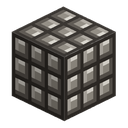
Crafted at a table from bricks, iron ingots, a machine casing and an electronic circuit. Reachable before any alloy exists, or the smelter could never be built.
Related
The Macerator and the Compressor form the ore-doubling loop: dust becomes an ingot, and the ingot then goes into the smelter. Tin, Nickel and Silver are the mod's own metals that go into the alloys.
Crafting
Shaped Crafting


▶
Alloy Smelter